
Use of Dropout and Batch Normalization in 2D CNN on Dog Cat Image Classification in TensorFlow 2.0
In this blog, we will build a Convolutional Neural Network that predicts whether an image is a cat or a dog. The dataset is from the Kaggle Cat and Dog dataset. It has two classes, cats and dogs, and the model predicts which class an image belongs to.
Download Data from GitHub and Model Building
This tutorial uses tensorflow 2.3 to build the model. Install TensorFlow by running this command.
!pip install tensorflow-gpu==2.3.0-rc0Importing necessary library that will use in model building.
import tensorflow as tf
from tensorflow import keras
from tensorflow.keras import Sequential
from tensorflow.keras.layers import Flatten, Dense, Conv2D, MaxPool2D, ZeroPadding2D, Dropout, BatchNormalization
from tensorflow.keras.preprocessing.image import ImageDataGenerator

from tensorflow.keras.optimizers import SGD

print(tf.__version__)2.3.0pandas for loading and manipulating the data.
pyplot from matplotlib is used to visualize the results.
import numpy as np
import matplotlib.pyplot as plt
git clone is a Git command-line utility that is used to target an existing repository and create a clone, or copy of the target repository.
!git clone https://github.com/laxmimerit/dog-cat-full-dataset.gitCloning into 'dog-cat-full-dataset'...
remote: Enumerating objects: 25027, done.
remote: Total 25027 (delta 0), reused 0 (delta 0), pack-reused 25027
Receiving objects: 100% (25027/25027), 541.62 MiB | 37.27 MiB/s, done.
Resolving deltas: 100% (5/5), done.
Checking out files: 100% (25001/25001), done.test_data_dir = '/content/dog-cat-full-dataset/data/test'
train_data_dir = '/content/dog-cat-full-dataset/data/train'Size of these images are quite large due to limited resources we are going to resize the image in the 32 x 32.
img_width = 32
img_height = 32
batch_size = 20
ImageDataGenerator makes batches of image data with real-time augmentation. We pass an argument to rescale the pixels from 0-255 down to 0-1, which speeds up learning.
datagen = ImageDataGenerator(rescale=1./255)The code reads images into a numerical array from the directory. The train_data_dir path is passed along with target_size (the size images are read at), classes set to dogs and cats, class_mode set to binary for this two-class problem, and batch_size of 20.
train_generator = datagen.flow_from_directory(directory=train_data_dir,
                                              target_size = (img_width, img_height),
                                              classes = ['dogs', 'cats'],
                                              class_mode = 'binary',
batch_size=batch_size)Found 20000 images belonging to 2 classes.It will give the class i.e. it has two class 0 and 1(Dogs and Cats).
train_generator.classesarray([0, 0, 0, ..., 1, 1, 1], dtype=int32)For validation, datagen.flow_directory takes the test_data_dir directory, target_size, classes for dogs and cats, class_mode binary for the two-class problem, and batch_size of 20.
validation_generator = datagen.flow_from_directory(directory=test_data_dir,
                                                   target_size = (32, 32),
                                                   classes = ['dogs', 'cats'],
                                                   class_mode = 'binary',
batch_size = batch_size)Found 5000 images belonging to 2 classes.Checking the length of data_generator:
data_generator = train_generator * batch_size
len(train_generator)*batch_size20000Build CNN Base Model
A Sequential() function is the easiest way to build a model in Keras. It lets us build a model layer by layer. Each layer has weights that correspond to the layer the follows it. We use the add() function to add layers to our model.
A 2D convolution layer takes a three-dimensional input, for example a color image with a red, blue, and green value at each pixel. We still call it a 2D convolution because the filter moves across the image in two dimensions.
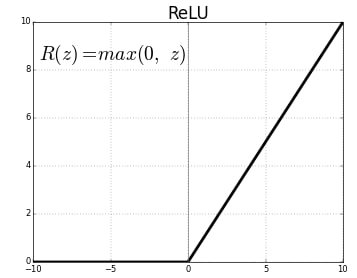
The Rectified Linear Unit (ReLU) is the most used activation function in deep learning. It returns 0 for any negative input, and for any positive value x it returns x. So we can write it as f(x)=max(0,x)
To stop problem of shrinkage of data we use concept called Padding.
It has two types:
- valid
- same
Max pooling down-samples the input, whether that is an image or a hidden-layer output. It shrinks the size and lets the model reason about the features in each small region. This helps with over-fitting by giving a simpler view of the data. It also cuts the compute cost, since there are fewer parameters to learn, and it adds basic shift invariance.
Flattening is converting the data into a 1-dimensional array for inputting it to the next layer. We flatten the output of the convolutional layers to create a single long feature vector.
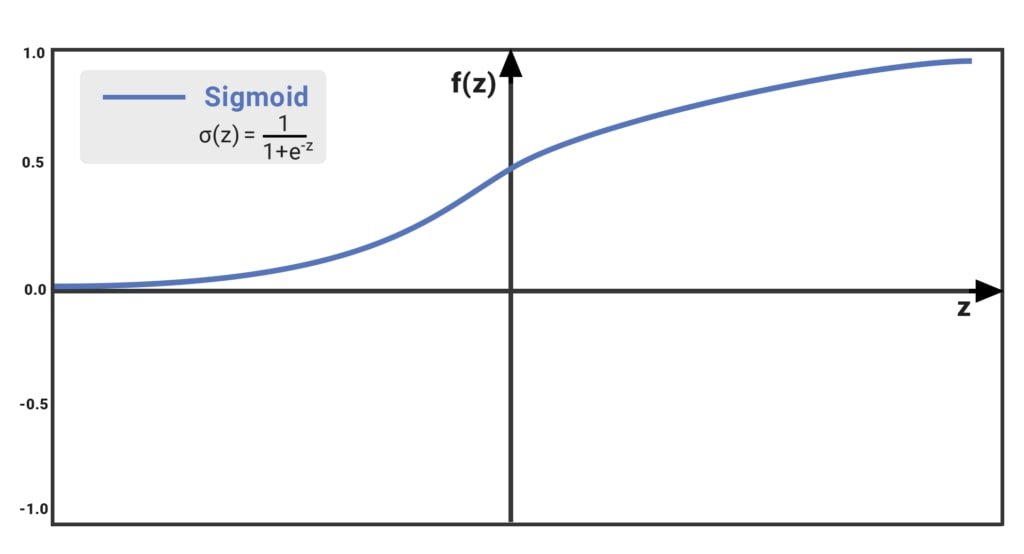
The Sigmoid function takes a value and returns another value between 0 and 1. It is non-linear and easy to work with. It is also smooth across all values of z and has a fixed output range.
model = Sequential()
model.add(Conv2D(filters=64, kernel_size=(3,3), activation='relu', padding='same', kernel_initializer='he_uniform', input_shape = (img_width, img_height, 3)))
model.add(MaxPool2D(2,2))

model.add(Flatten())
model.add(Dense(128, activation='relu', kernel_initializer='he_uniform'))
model.add(Dense(1, activation='sigmoid'))
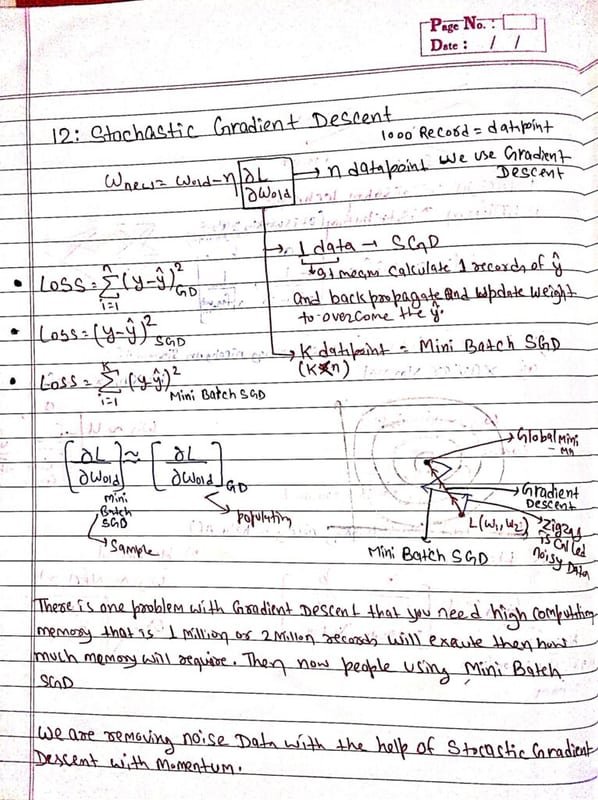
The diagram below shows the key differences between Gradient Descent, Stochastic Gradient Descent, and Mini-Batch SGD, which is the optimizer variant used here:
Compile defines the loss function, the optimizer and the metrics. That's all. It has nothing to do with the weights, and we can compile a model as many times as we want without causing any problem to pretrained weights.
opt = SGD(learning_rate=0.01, momentum=0.9)
model.compile(optimizer=opt, loss='binary_crossentropy', metrics=['accuracy'])
The model.fit_generator() function accepts the batch of data, performs backpropagation, and updates the weights in our model. This process is repeated until we have reached the desired number of epochs.
history = model.fit_generator(generator=train_generator, steps_per_epoch=len(train_generator), epochs = 5, validation_data=validation_generator, validation_steps=len(validation_generator), verbose = 1)WARNING:tensorflow:From :1: Model.fit_generator (from tensorflow.python.keras.engine.training) is deprecated and will be removed in a future version.
Instructions for updating:
Please use Model.fit, which supports generators.
Epoch 1/5
1000/1000 [==============================] - 100s 100ms/step - loss: 0.6971 - accuracy: 0.5077 - val_loss: 0.6926 - val_accuracy: 0.5000
Epoch 2/5
1000/1000 [==============================] - 99s 99ms/step - loss: 0.6892 - accuracy: 0.5205 - val_loss: 0.6898 - val_accuracy: 0.5320
Epoch 3/5
1000/1000 [==============================] - 100s 100ms/step - loss: 0.6760 - accuracy: 0.5673 - val_loss: 0.6754 - val_accuracy: 0.5724
Epoch 4/5
1000/1000 [==============================] - 99s 99ms/step - loss: 0.6068 - accuracy: 0.6747 - val_loss: 0.5471 - val_accuracy: 0.7260
Epoch 5/5
1000/1000 [==============================] - 99s 99ms/step - loss: 0.5346 - accuracy: 0.7325 - val_loss: 0.5180 - val_accuracy: 0.7474history.history{'accuracy': [0.5077000260353088, 0.5205000042915344, 0.567300021648407, 0.6747000217437744, 0.732450008392334], 'loss': [0.6971414089202881, 0.6891948580741882, 0.6759502291679382, 0.6068235635757446, 0.5346073508262634], 'val_accuracy': [0.5, 0.5320000052452087, 0.5723999738693237, 0.7260000109672546, 0.7473999857902527], 'val_loss': [0.692634642124176, 0.6898210644721985, 0.6753650903701782, 0.5471111536026001, 0.5179951190948486]}def plot_learningCurve(history):
# Plot training & validation accuracy values
epoch_range = range(1, 6)
plt.plot(epoch_range, history.history['accuracy'])
plt.plot(epoch_range, history.history['val_accuracy'])
plt.title('Model accuracy')
plt.ylabel('Accuracy')
plt.xlabel('Epoch')
plt.legend(['Train', 'Val'], loc='upper left')
plt.show()
# Plot training & validation loss values
plt.plot(epoch_range, history.history['loss'])
plt.plot(epoch_range, history.history['val_loss'])
plt.title('Model loss')
plt.ylabel('Loss')
plt.xlabel('Epoch')
plt.legend(['Train', 'Val'], loc='upper left')
plt.show()In the Model loss figure, the validation loss is always less than the training loss, which means our model is underfitting. In the Model Accuracy figure, the validation accuracy is greater than the training accuracy, so our model is not overfitting at all and we can increase the number of epochs.
plot_learningCurve(history)Implement First 3 Blocks of VGG16 Model
The 3-block VGG16 Model structure is as follows:
- In the first block, it has to take 64 filters.
- In the second block, we are taking 128 filters.
- And at the last third block, we are going to use 256 filters.
model = Sequential()
model.add(Conv2D(filters=64, kernel_size=(3,3), activation='relu', padding='same', kernel_initializer='he_uniform', input_shape = (img_width, img_height, 3)))
model.add(MaxPool2D(2,2))

model = Sequential()
model.add(Conv2D(filters=128, kernel_size=(3,3), activation='relu', padding='same', kernel_initializer='he_uniform'))
model.add(MaxPool2D(2,2))

model = Sequential()
model.add(Conv2D(filters=256, kernel_size=(3,3), activation='relu', padding='same', kernel_initializer='he_uniform'))
model.add(MaxPool2D(2,2))

model.add(Flatten())
model.add(Dense(128, activation='relu', kernel_initializer='he_uniform'))

model.add(Dense(1, activation='sigmoid'))opt = SGD(learning_rate=0.01, momentum=0.9)
model.compile(optimizer=opt, loss='binary_crossentropy', metrics=['accuracy'])history = model.fit_generator(generator=train_generator, steps_per_epoch=len(train_generator), epochs = 5, validation_data=validation_generator, validation_steps=len(validation_generator), verbose = 1)Epoch 1/5
1000/1000 [==============================] - 174s 174ms/step - loss: 0.7074 - accuracy: 0.4951 - val_loss: 0.6932 - val_accuracy: 0.5000
Epoch 2/5
1000/1000 [==============================] - 177s 177ms/step - loss: 0.6935 - accuracy: 0.4978 - val_loss: 0.6932 - val_accuracy: 0.5000
Epoch 3/5
1000/1000 [==============================] - 179s 179ms/step - loss: 0.6934 - accuracy: 0.5002 - val_loss: 0.6931 - val_accuracy: 0.4998
Epoch 4/5
1000/1000 [==============================] - 175s 175ms/step - loss: 0.6935 - accuracy: 0.4945 - val_loss: 0.6950 - val_accuracy: 0.5000
Epoch 5/5
1000/1000 [==============================] - 172s 172ms/step - loss: 0.6936 - accuracy: 0.4969 - val_loss: 0.6931 - val_accuracy: 0.5002With this approach the accuracy is very poor. Val_accuracy is 50% and training accuracy is also around 50%. For binary classification, 50% accuracy means the model is guessing at random. This happened because a very complex model was applied to a small dataset.
To increase the accuracy we are going to add Batch Normalization and Dropout to achieve better accuracy.
Batch Normalization and Dropout
model = Sequential()
model.add(Conv2D(filters=64, kernel_size=(3,3), activation='relu', padding='same', kernel_initializer='he_uniform', input_shape = (img_width, img_height, 3)))
model.add(BatchNormalization())
model.add(MaxPool2D(2,2))
model.add(Dropout(0.2))

model = Sequential()
model.add(Conv2D(filters=128, kernel_size=(3,3), activation='relu', padding='same', kernel_initializer='he_uniform'))
model.add(BatchNormalization())
model.add(MaxPool2D(2,2))
model.add(Dropout(0.3))

model = Sequential()
model.add(Conv2D(filters=256, kernel_size=(3,3), activation='relu', padding='same', kernel_initializer='he_uniform'))
model.add(BatchNormalization())
model.add(MaxPool2D(2,2))
model.add(Dropout(0.5))

model.add(Flatten())
model.add(Dense(128, activation='relu', kernel_initializer='he_uniform'))
model.add(BatchNormalization())
model.add(Dropout(0.5))

model.add(Dense(1, activation='sigmoid'))opt = SGD(learning_rate=0.01, momentum=0.9)
model.compile(optimizer=opt, loss='binary_crossentropy', metrics=['accuracy'])history = model.fit_generator(generator=train_generator, steps_per_epoch=len(train_generator), epochs = 10, validation_data=validation_generator, validation_steps=len(validation_generator), verbose = 1)Epoch 1/10
1000/1000 [==============================] - 239s 239ms/step - loss: 0.6800 - accuracy: 0.6283 - val_loss: 0.6531 - val_accuracy: 0.6644
...
Epoch 5/10
1000/1000 [==============================] - 240s 240ms/step - loss: 0.5136 - accuracy: 0.7496 - val_loss: 0.5080 - val_accuracy: 0.7592
Epoch 6/10
1000/1000 [==============================] - 239s 239ms/step - loss: 0.5006 - accuracy: 0.7584 - val_loss: 0.5198 - val_accuracy: 0.7514
Epoch 7/10
1000/1000 [==============================] - 242s 242ms/step - loss: 0.4929 - accuracy: 0.7609 - val_loss: 0.5420 - val_accuracy: 0.7270
Epoch 8/10
1000/1000 [==============================] - 240s 240ms/step - loss: 0.4957 - accuracy: 0.7623 - val_loss: 0.5901 - val_accuracy: 0.7068
Epoch 9/10
1000/1000 [==============================] - 243s 243ms/step - loss: 0.4846 - accuracy: 0.7678 - val_loss: 0.5548 - val_accuracy: 0.7288
Epoch 10/10
1000/1000 [==============================] - 240s 240ms/step - loss: 0.4648 - accuracy: 0.7781 - val_loss: 0.5182 - val_accuracy: 0.7406Adding Batch Normalisation and Dropout produced a small but meaningful accuracy gain over the previous run, and the epochs were also increased from 5 to 10.
def plot_learningCurve(history, epoch):
  # Plot training & validation accuracy values
  epoch_range = range(1, epoch+1)
  plt.plot(epoch_range, history.history['accuracy'])
  plt.plot(epoch_range, history.history['val_accuracy'])
  plt.title('Model accuracy')
  plt.ylabel('Accuracy')
  plt.xlabel('Epoch')
  plt.legend(['Train', 'Val'], loc='upper left')
  plt.show()

  # Plot training & validation loss values
  plt.plot(epoch_range, history.history['loss'])
  plt.plot(epoch_range, history.history['val_loss'])
  plt.title('Model loss')
  plt.ylabel('Loss')
  plt.xlabel('Epoch')
  plt.legend(['Train', 'Val'], loc='upper left')
plt.show()plot_learningCurve(history, 10)In the Model accuracy fig. The accuracy of training data has kept increasing but the accuracy of validation data stops after 5 or 6 epochs.
In the Model loss fig. After 5 epochs validation loss starts increasing than training loss.
So moreover this learning curve we can identify that our model has started overfitting.
Note: In this blog, we clearly see that Dropout and Batch Normalisation have a great impact on a Deep Neural Network.
Conclusion
In this blog, we trained a 2D CNN to classify dog and cat images. We went through three model variants: a basic Conv2D baseline (about 73% validation accuracy), a 3-block VGG16-style model (50%, too complex for the dataset), and a 3-block model with BatchNormalization and Dropout (about 74% at epoch 5 before overfitting). The learning curves clearly showed overfitting setting in after epoch 5.
Key takeaways:
- Matching model depth to dataset size is critical: a deep VGG-style architecture collapsed to random guessing on 20,000 images without regularization.
BatchNormalizationandDropouttogether recovered meaningful learning but could not prevent overfitting past epoch 5; stronger augmentation is needed for further improvement.ImageDataGeneratorwithrescale=1./255is the minimum preprocessing pipeline for image classification; adding flipping, rotation, and zoom augmentation would noticeably reduce overfitting.
Next steps:
- Use transfer learning with VGG-16 for Image Classification to achieve substantially higher accuracy without training from scratch.
- Apply multi-class image classification with CNN on CIFAR-10 to extend the same CNN concepts to 10 categories.
- Add horizontal flipping and random zoom to the
ImageDataGeneratorto reduce the overfitting gap seen after epoch 5.