Read this sentence: the trophy did not fit in the suitcase because it was too big.
What does it mean here? We all read it as the trophy, and nobody had to stop and think. Now we change one word: because it was too small. Now it is the suitcase. One word flipped, and the meaning of a different word moved with it.
This is the problem attention was built to solve. In this blog, we will learn why the embeddings from the last two lessons cannot fix it, and what we have to add on top of them.
Note
The code below needs only NumPy: pip install numpy. Real models use hundreds of dimensions. We use three, so every number stays on the screen.
The Sentence That Breaks a Bag of Vectors
One word, two meanings
Let's put the two sentences side by side. Only the last word changes.
- the trophy did not fit in the suitcase because it was too big → it is the trophy
- the trophy did not fit in the suitcase because it was too small → it is the suitcase
The word it did not move. Nothing next to it changed either. Still its meaning flipped, and the cause is the last word, three places after it.
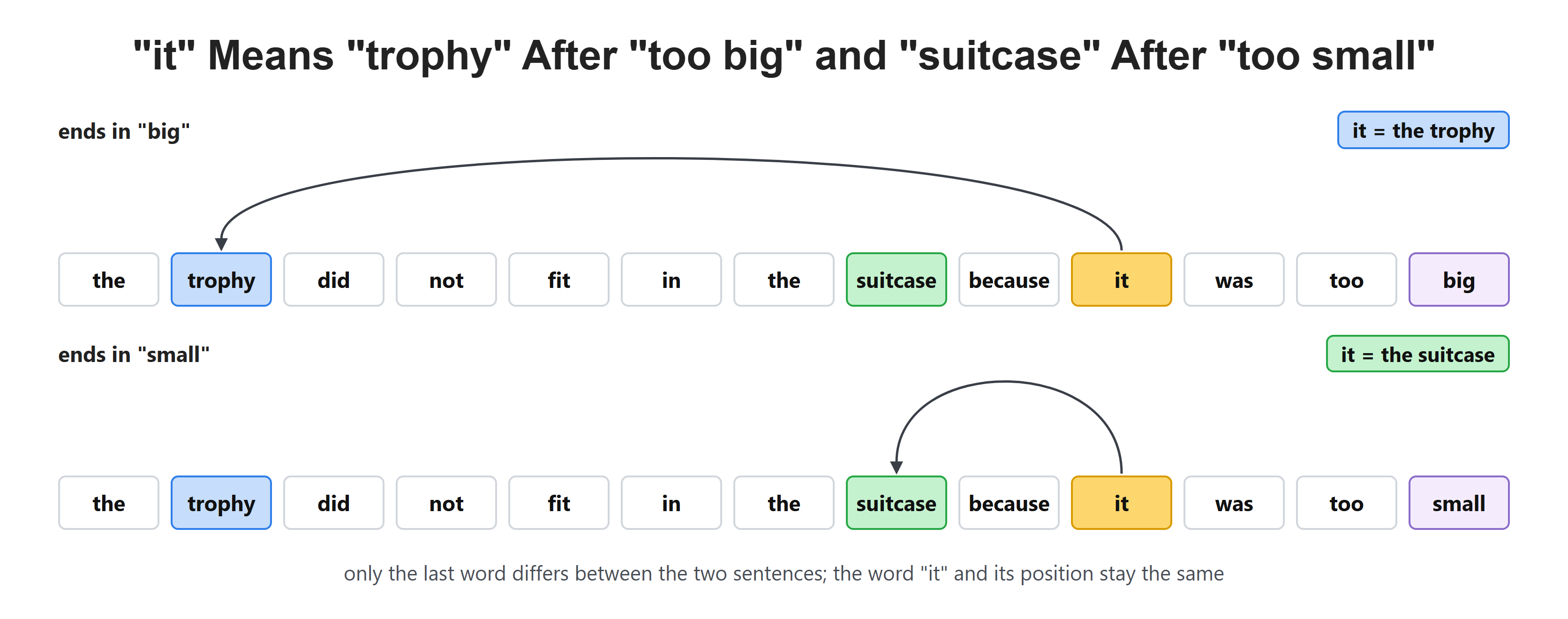
Change one adjective and the referent of "it" swaps. The word itself never changes.
Why yesterday's embeddings cannot help
Two lessons back we saw that the embedding table gives each token one fixed row. We look up the same token twice, and we get the same numbers twice. Let's see the code as below:
import numpy as np

#                    heavy  roomy  object
trophy   = np.array([0.90, 0.10, 0.80])
suitcase = np.array([0.20, 0.90, 0.80])
it       = np.array([0.50, 0.50, 0.50])

# the same token in both sentences
it_in_sentence_a = it
it_in_sentence_b = it

print("same vector in both sentences?", np.array_equal(it_in_sentence_a, it_in_sentence_b))
print("it =", it)same vector in both sentences? True
it = [0.5 0.5 0.5]Here, we can see True, and that is the whole problem. The table hands back one vector for it. It is the same vector in the sentence about a big trophy and in the sentence about a small suitcase. A fixed embedding table has no way to tell the two apart.
What Attention Adds
Every word looks around
So, here comes attention to the rescue. Attention gives every word one new ability. In simple words, a word can look at every other word in the sentence and decide which ones matter to it.
For it, that means looking at trophy and at suitcase, then leaning toward the one that fits better. The rest of the sentence gives the clue, and the word big or small is what tips the balance.
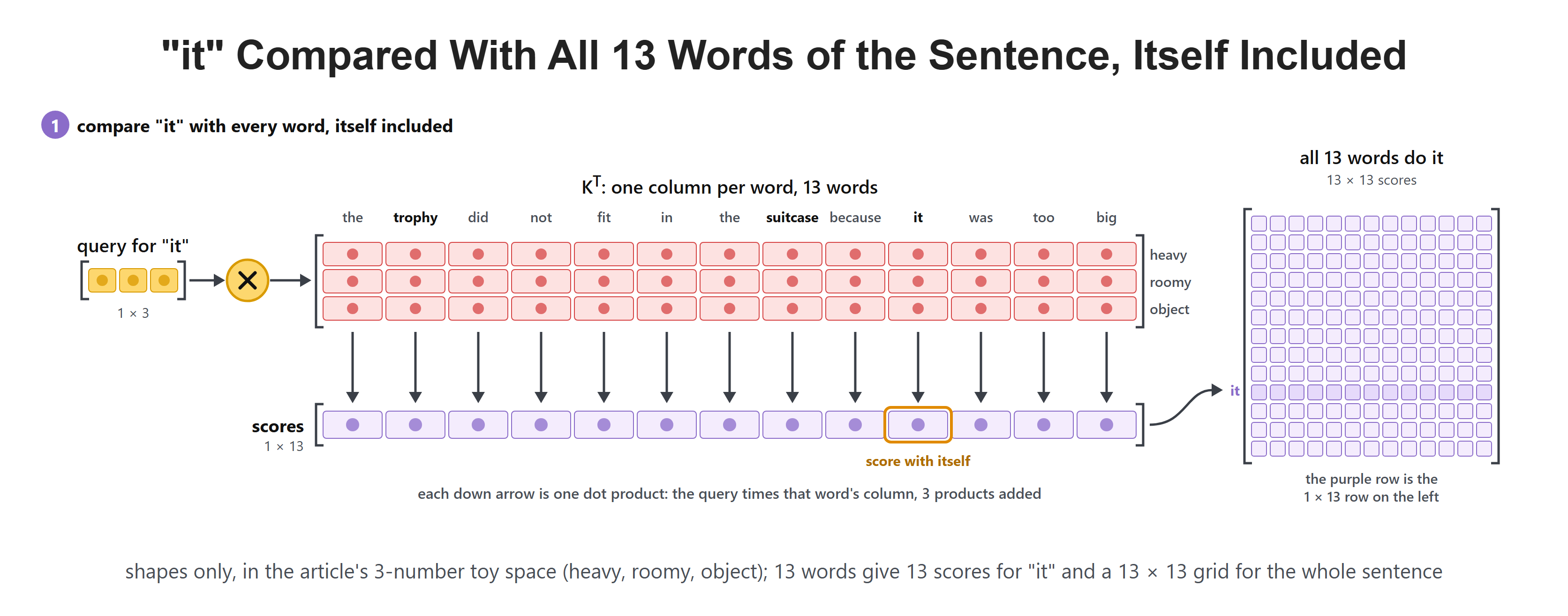
Each word compares itself against all the others, including itself.
Scores, then weights
The comparison is a dot product. We multiply the two vectors position by position, then we add up the results. A bigger number means a stronger match.
In our demo, it does not use its raw table row for this comparison. Instead, we pick a query vector by hand that carries a hint from the rest of the sentence. In our small space, too big pushes the query toward the heavy dimension, and too small pushes it toward the roomy one. Let's see the code as below:
q_big   = np.array([0.95, 0.05, 0.10])   # "it ... too big"
q_small = np.array([0.05, 0.95, 0.10])   # "it ... too small"

scores_big = np.array([q_big @ trophy, q_big @ suitcase])
print("scores with 'big' :", scores_big.round(2))scores with 'big' : [0.94 0.32]Raw scores are hard to read. So we pass them through softmax. Softmax turns the scores into weights, and those weights are always positive and always add up to 1.
def softmax(x):
    e = np.exp(x - x.max())
    return e / e.sum()

weights_big = softmax(scores_big * 5)
print("weights with 'big' :", weights_big.round(2))
print("they add up to :", weights_big.sum().round(2))weights with 'big' : [0.96 0.04]
they add up to : 1.0Here, we can see the answer the model gives us: 96% trophy, 4% suitcase.
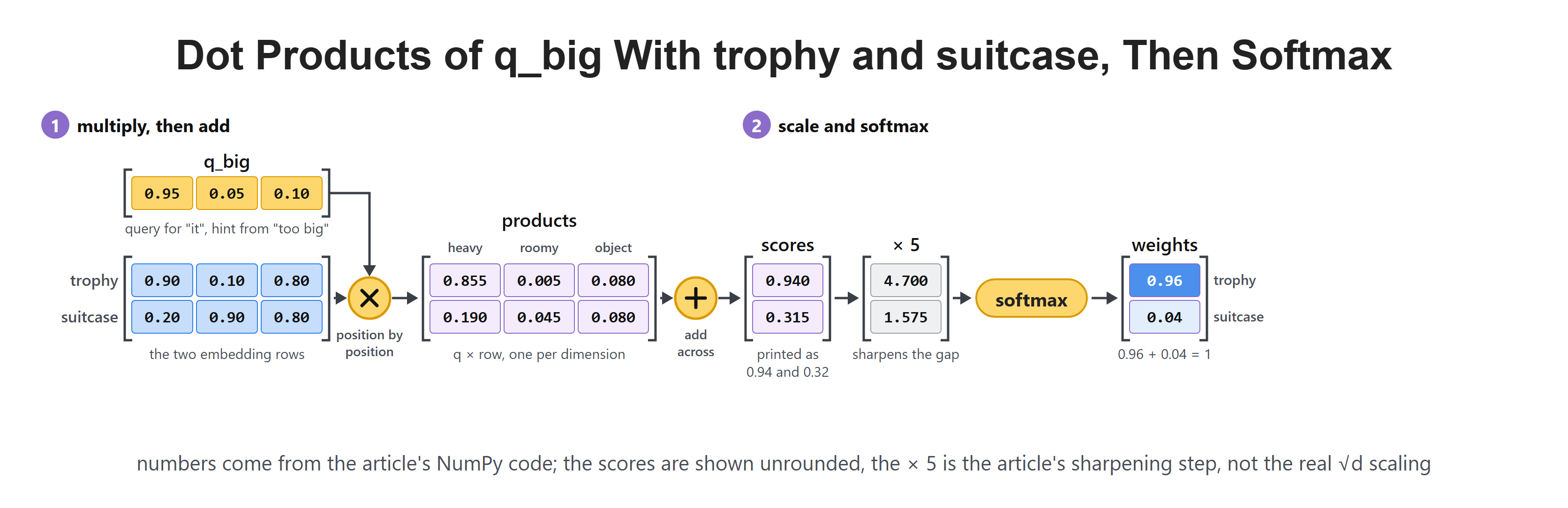
Dot product first, softmax second. The scores can be any size; the weights always add to 1.
Note
The * 5 sharpens the difference so it is easy to read. Real attention divides the scores by the square root of the vector size instead. We come back to that later in this series.
The new vector for "it"
Those weights now decide how we mix the other words. We take 96% of the trophy vector, 4% of the suitcase vector, and we add them together. Let's see the code as below:
new_it = weights_big[0] * trophy + weights_big[1] * suitcase
print("new vector for 'it':", new_it.round(2))
print("trophy was :", trophy)new vector for 'it': [0.87 0.13 0.8 ]
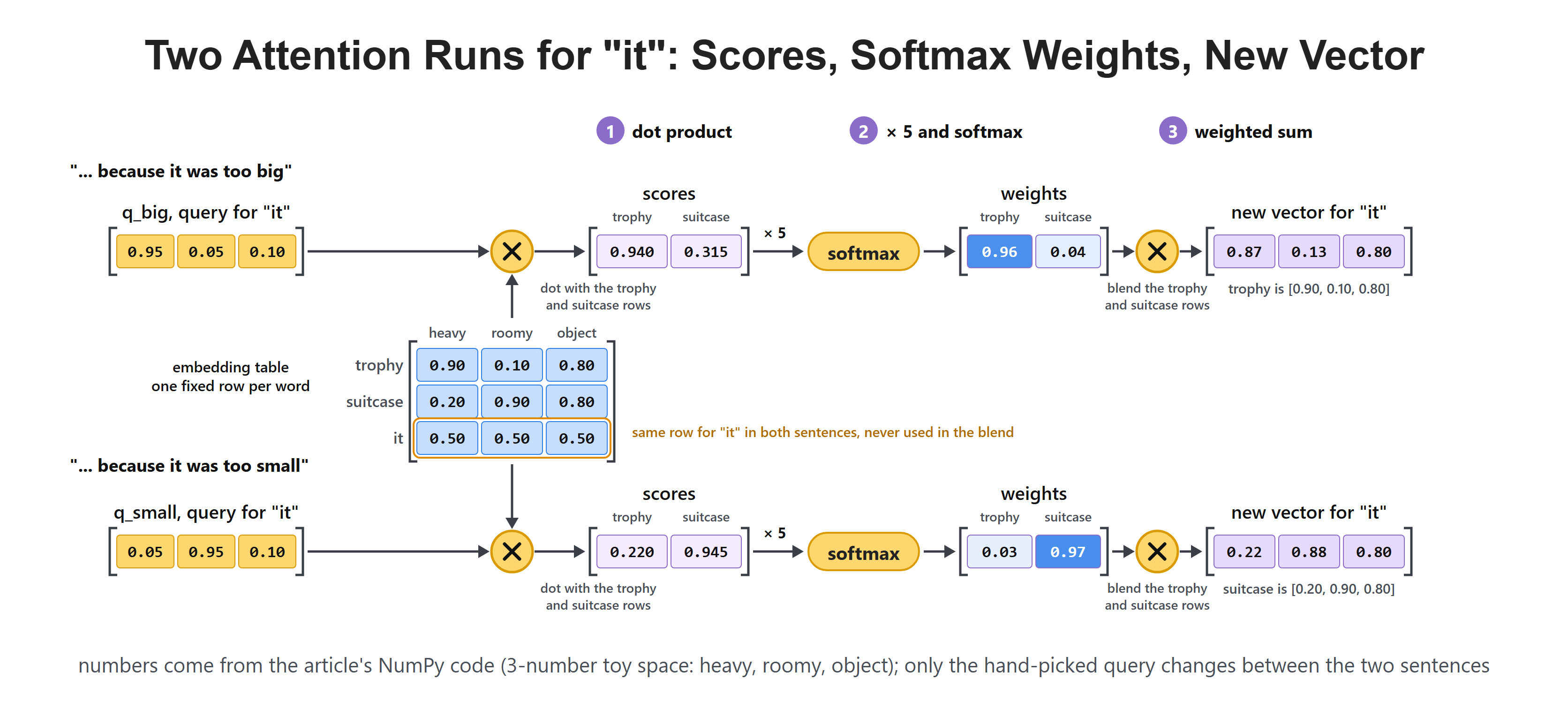
trophy was : [0.9 0.1 0.8]Here, we can see that the new vector for it sits almost on top of trophy. It is built only from the trophy and suitcase vectors. The table row for it, [0.5, 0.5, 0.5], never enters this sum. The hand-picked query did the work of asking on behalf of it.
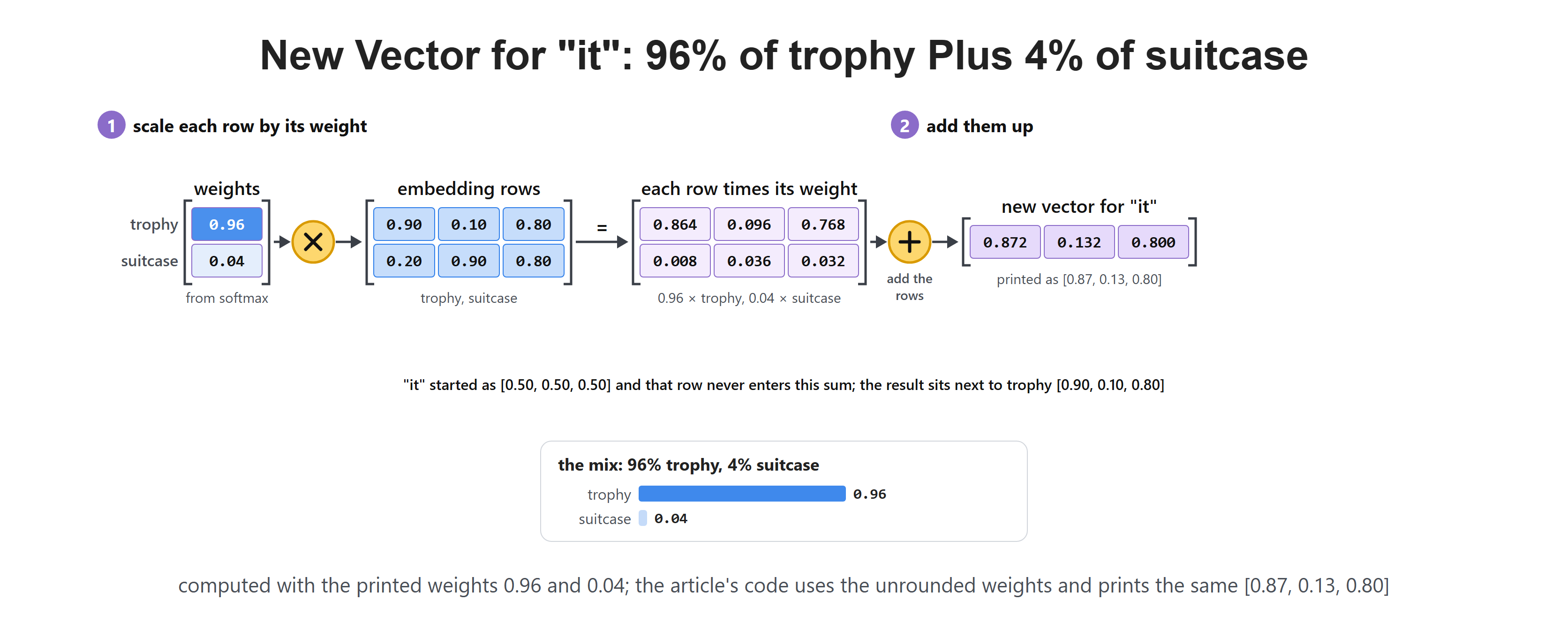
The output is a blend of the other words, mixed in proportion to the weights.
Reading the Result
Now we run the same three steps on the other sentence. We change nothing else. Let's see the code as below:
scores_small  = np.array([q_small @ trophy, q_small @ suitcase])
weights_small = softmax(scores_small * 5)
new_it_small  = weights_small[0] * trophy + weights_small[1] * suitcase

print("weights with 'small':", weights_small.round(2))
print("new vector for 'it' :", new_it_small.round(2))
print("suitcase was :", suitcase)weights with 'small': [0.03 0.97]
new vector for 'it' : [0.22 0.88 0.8 ]
suitcase was : [0.2 0.9 0.8]Here, we can see the same word and the same table, but two different answers. Only the query changed, because the words around it changed.
This is exactly the job of attention, and we have just watched it happen with plain NumPy.
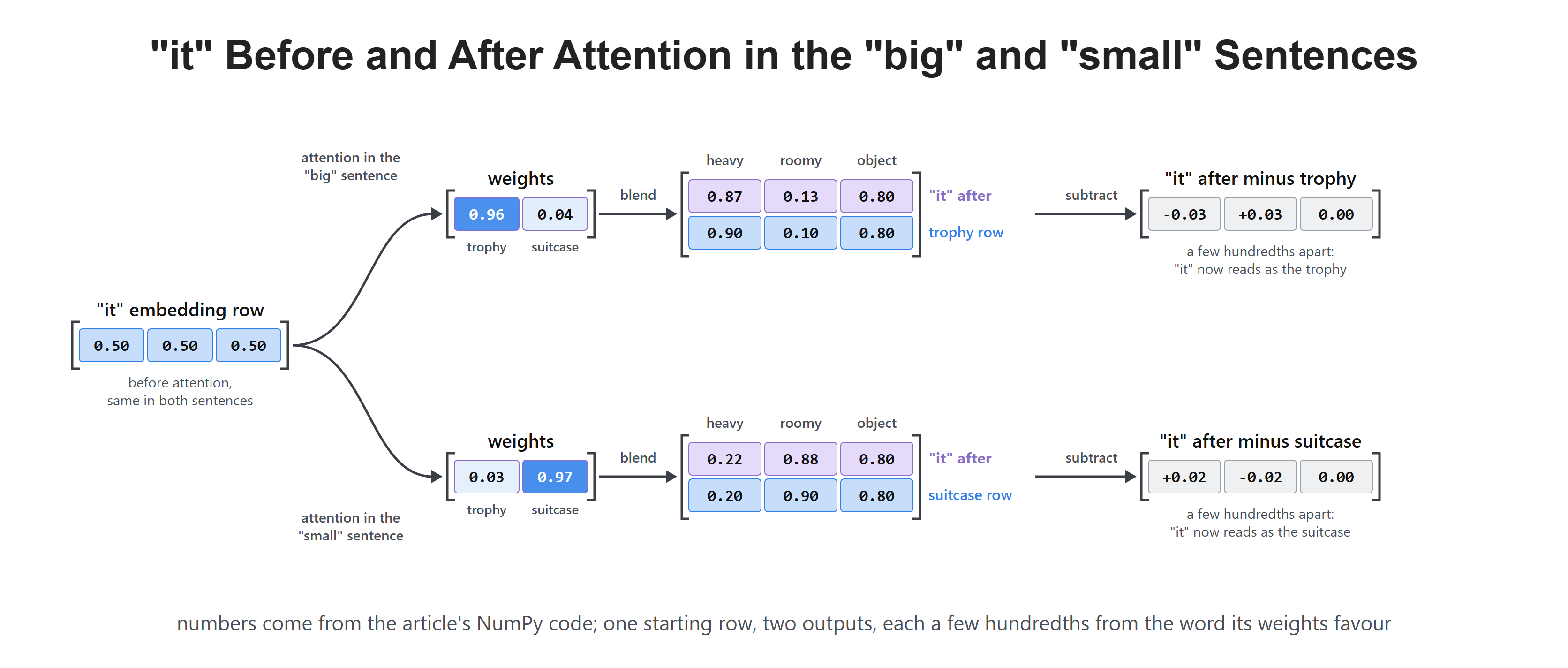
One token, one embedding row, two outputs. The context did the work.
The Weights Are Learned, Not Written
Nobody wrote a rule saying that big points at trophies. We picked our query vectors by hand so the demo stays easy to read. A real model does not get that help.
A real model starts with random numbers. It reads text and predicts the next word. When it is wrong, it nudges the numbers that caused the mistake. After enough training, the pattern that says "a size word tells us which object it means" is simply the setup that predicted best.
Nobody taught the model that rule. The model found it.
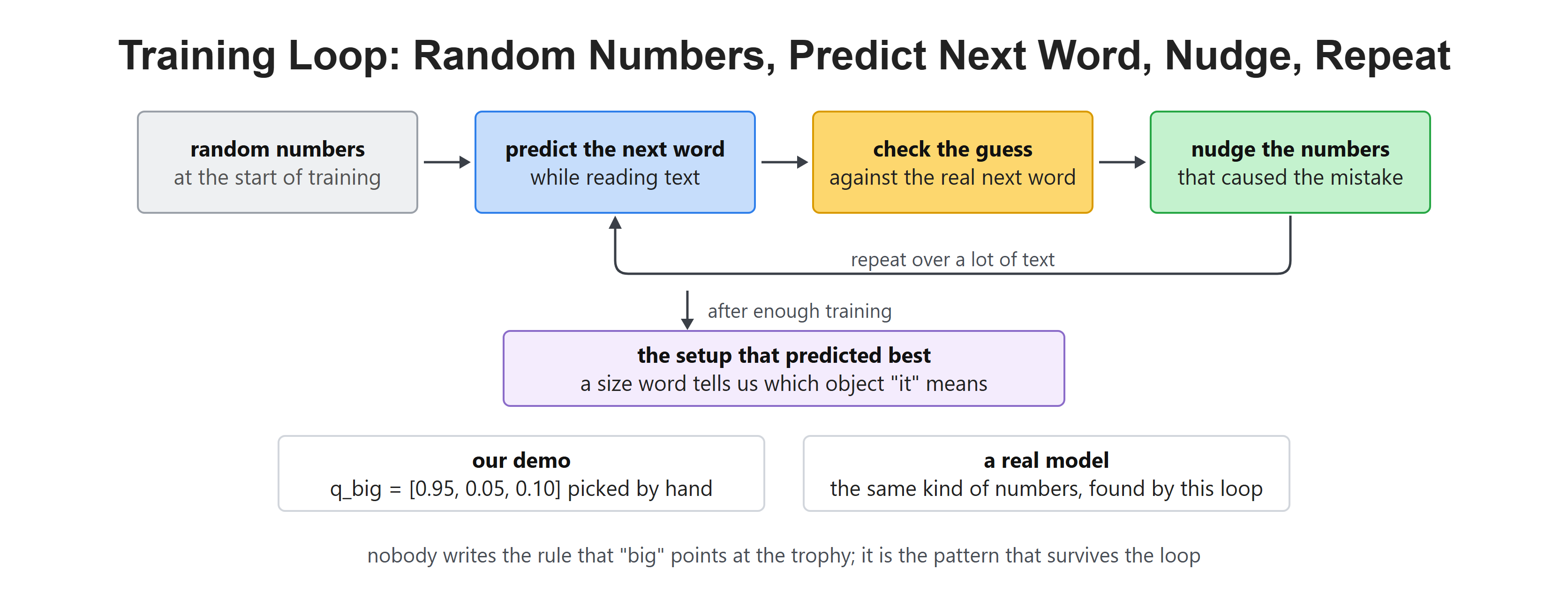
Random at the start, shaped by guess after guess over a lot of text.
Why Word Order Alone Is Not Enough
An older answer was to read the sentence from left to right and carry a running memory along the way. That works fine until the clue we need sits far away.
In our sentence, trophy sits eight places before it. That gap could just as easily be forty words. Reading in order forces the model to keep every word it might need inside one small memory. It also has to drag that memory past every word in between. Long gaps are where those models lost the thread.
Attention removes that journey. Every word can reach every other word in one step, however far apart they sit.
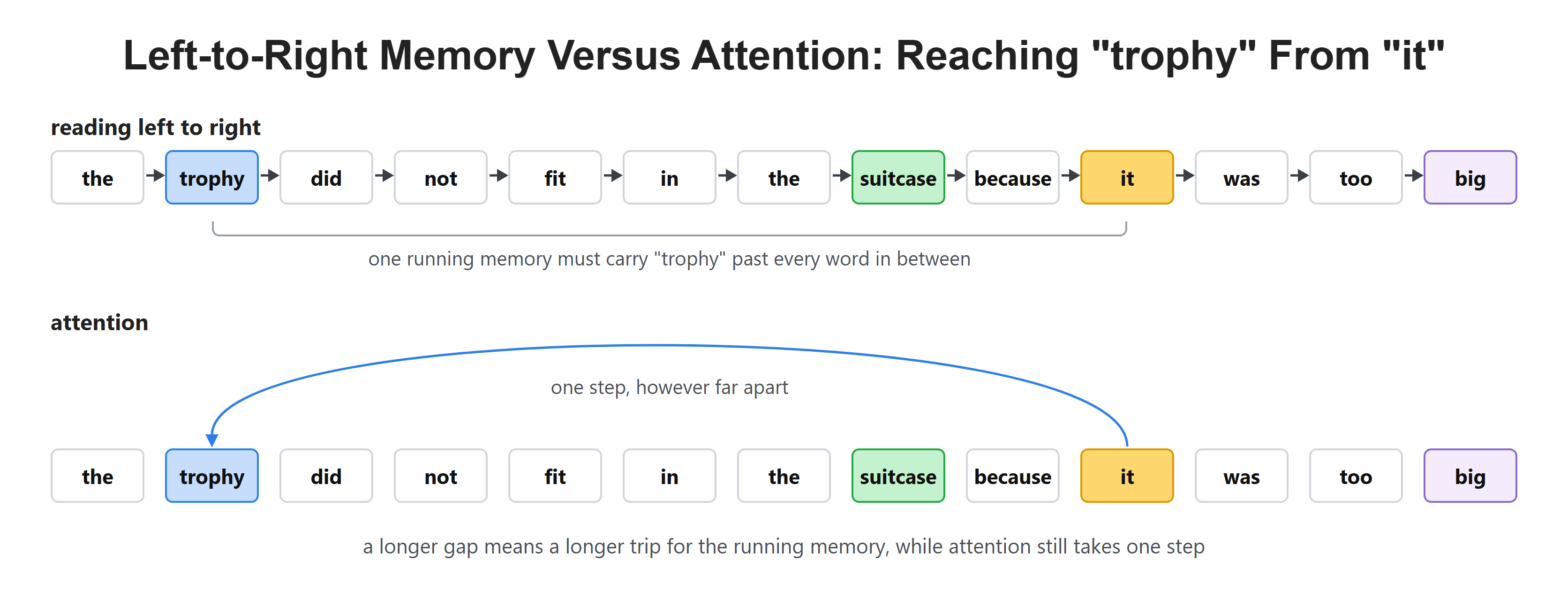
A running memory has to carry the clue the whole way. Attention jumps straight to it.
What This Costs
Connecting every word to every other word is not free. Ten words need one hundred comparisons. One hundred words need ten thousand.
The work grows with the square of the sentence length. We double the sentence, and the cost goes up four times, not two. That one fact drives most of the second half of this series, from the KV cache to Flash Attention.
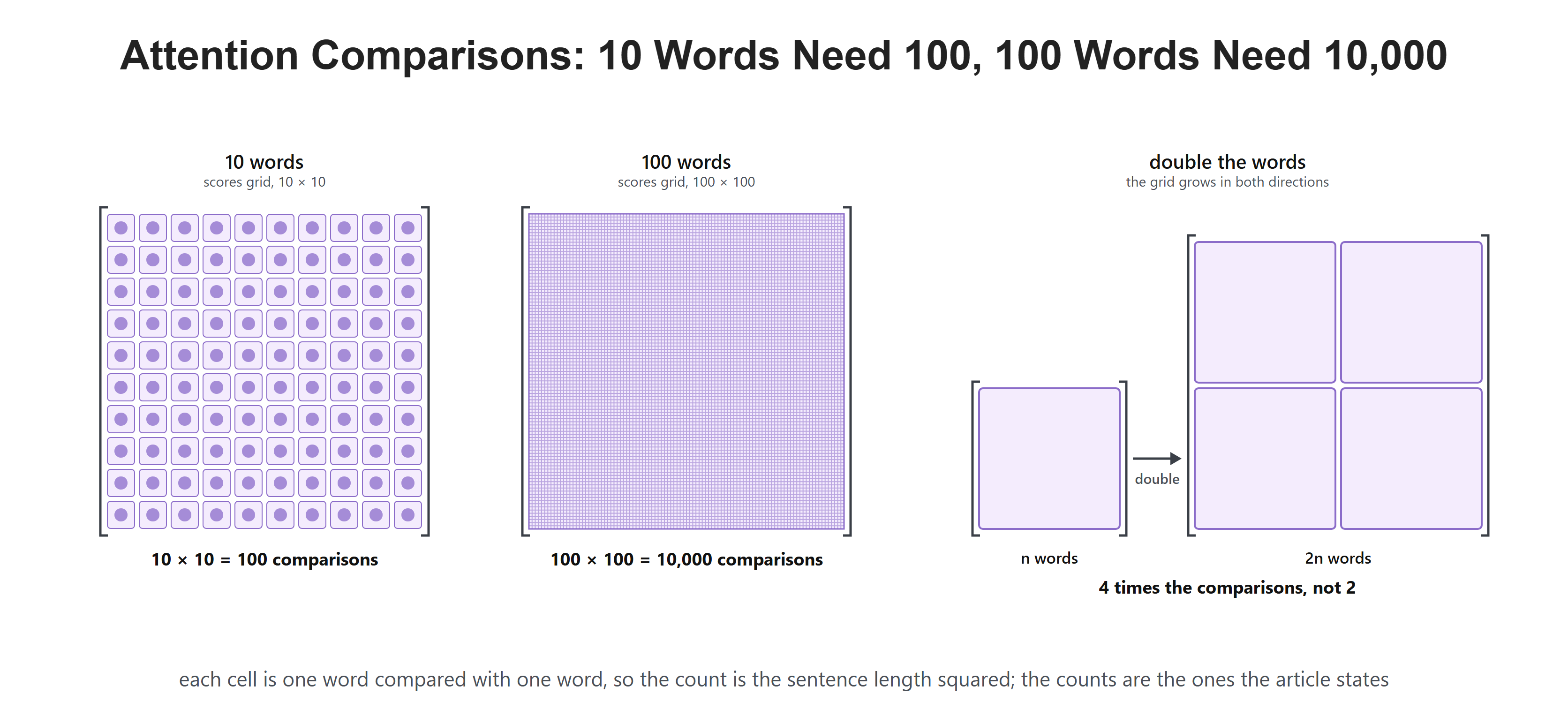
Every word compares against every word, so the count grows as the square of the length.
Recap
This is how attention works. We started with a sentence that breaks a bag of fixed vectors. The word it means two different things in two sentences, but the embedding table returns the same row both times.
Attention fixes this by letting every word look at every other word. It scores each pair with a dot product, turns those scores into weights with softmax, and builds a new vector by mixing the other words in those proportions. In our small run, it came out 96% trophy in one sentence and 97% suitcase in the other, while the table still held one row for it.
Nobody wrote those weights. They are what falls out of predicting text well, again and again. And every word reaching every word costs work that grows with the square of the sentence length. That is a bill the rest of this series spends a lot of time paying down.
In the next lesson we name the three vectors this mechanism really uses: query, key and value. We will see exactly which job each one does.